מצאתם טעות? שלחו הודעה קצרה. גם אם זה רק שגיעת כתיב קטנה. תודה לינאי וגיל ששיכנעו אותי להוסיף את זה...
THP1_004 Collisions Between Particles
• זמן קריאה: 16 דק'
Disintegration of Particles
In many cases the laws of conservation of momentum and energy alone can be used to obtain important results concerning the properties of various mechanical processes. It should be noted that these properties are independent of the particular type of interaction between the particles involved.
Let us consider a “spontaneous” disintegration (this is, one not due to external forces) of a particle into two “constituent parts”, i.e. into two other particles which move independently after the disintegration.
This process is most simply described in a frame of reference in which the particle is at rest before the disintegration. The law of conservation of momentum shows that the sum of the momenta of the two particles formed in the disintegration is then zero; that is, the particles move apart with equal and opposite momenta. The magnitude of either momentum is given by the laws of conservation of energy:
here and are the masses of the particles, and their internal energies, and the internal energy of the original particle. If is the “disintegration energy”, i.e. the difference
which must obviously be positive, then
which determines ; here is the reduced mass of the two particles. The velocities are and .
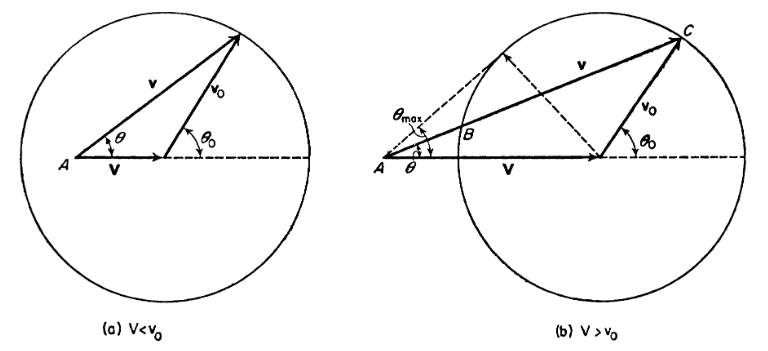
Let us now change to a frame of reference in which the primary particle moves with velocity before the break-up. This frame is usually called the laboratory system, or system, in contradistinction to the center of mass system, or system, in which the total momentum is zero. Let us consider one of the resulting particles, and let and be its velocities in the and system respectively. Evidently , or , and so
where is the angle at which this particle moves relative to the direction of the velocity . This equation gives the velocity of the particle as a function of its direction of motion in the system. In Figure 4.1 the velocity is represented by a vector drawn to any point on a circle of radius from a point at a distance from the center. The cases and are shown in (a) and (b) respectively. In the former case can have any value, but in the latter case the particle can move only forwards, at an angle which does not exceed , given by
This is the direction of the tangent from the point to the circle.
The relation between the angles and in the and systems is evidently
If this equation is solved for , we obtain
For the relation between and is one-to-one (Figure 4.1 (a)). The plus sign must be taken in (LL16.6) so that when . If , however, the relation is not one-to-one: for each value of there are two values of , which correspond to vectors drawn from the center of the circle to the points and (Figure 4.1 (b)), and are given by the two signs in (LL16.6).
In physical applications we are usually concerned with the disintegration of not one but many similar particles, and this raises the problem of the distribution of the resulting particles in direction, energy, etc. We shall assume that the primary particles are randomly oriented in space, i.e. isotropically on average.
In the system, this problem is very easily solved: every resulting particle (of a given kind) has the same energy, and their directions of motion are isotropically distributed. The latter fact depends on the assumption that the primary particles are randomly oriented, and can be expressed by saying that the fraction of particles entering a solid angle element is proportional to , i.e. equal to .
Unpacking the Paragraph Above
The key idea is to think statistically. Instead of tracking one disintegration, imagine a large ensemble of identical particles, each about to disintegrate. Since they are randomly oriented, the axis along which the two products fly apart points in a random direction - no direction is preferred.
In the system, the physics of the disintegration fixes the speed of each product (via energy/momentum conservation), but says nothing about the direction. Combined with the random orientation of the parent particle, this means the resulting particles are equally likely to fly off in any direction - they are isotropically distributed.
The solid angle element measures a small “patch” of directions on a sphere. The total solid angle of a full sphere is steradians. If directions are isotropic, the fraction of particles heading into any patch is simply the ratio .
The distribution with respect to the angle is obtained by putting , i.e. the corresponding fraction is
The corresponding distributions in the system are obtained by an appropriate transformation. For example, let us calculate the kinetic energy distribution in the system. Squaring the equation , we have , whence . Using the kinetic energy , where is or depending on which kind of particle is under consideration, and substituting in (LL16.7), we find the required distribution:
The kinetic energy can take values between and . The particles are, according to (LL16.8), distributed uniformly over this range.
When a particle disintegrates into more than two parts, the laws of conservation of energy and momentum naturally allow considerably more freedom as regards the velocities and directions of motion of the resulting particles. In particular, the energies of these particles in the system do not have determinate values. There is, however, an upper limit to the kinetic energy of any one of the resulting particles. To determine the limit, we consider the system formed by all these particles except the one concerned (whose mass is , say), and denote the “internal energy” of that system by . Then the kinetic energy of the particle is, by (LL16.1) and (LL16.2):
# Elastic Collisions A collision between two particles is said to be *elastic* if it involves no change in their internal state. Accordingly, when the law of conservation of energy is applied to such a collision, the internal energy of the particles may be neglected. The collision is most simply described in a frame of reference in which the center of mass of the two particles is at rest (the $C$ system). As in the previous section, we distinguish by the suffix $0$ the values of quantities in that system. The velocities of the particles before the collision are related to their velocities $\mathbf{v}_{1}$ and $\mathbf{v}_{2}$ in the laboratory system by $\mathbf{v}_{10}=\dfrac{{m}_{2}\mathbf{v}}{{m}_{1}+{m}_{2}}$ and $\mathbf{v}_{20}=-\dfrac{{m}_{1}\mathbf{v}}{{m}_{1}+{m}_{2}}$, where $\mathbf{v}=\mathbf{v}_{1}-\mathbf{v}_{2}$. Because of the law of conservation of momentum, the momenta of the two particles remain equal and opposite after the collision, and are also unchanged in magnitude, by the law of conservation of energy. Thus, in the $C$ system the collision simply rotates the velocities, which remain opposite in direction and unchanged in magnitude. If we denote by $\mathbf{n}_{0}$ a unit vector in the direction of the velocity of the particle ${m}_{1}$ after the collision, then the velocities of the two particles after the collision (distinguished by primes) are
where $m=\dfrac{{m}_{1}{m}_{2}}{{m}_{1}+{m}_{2}}$ is the reduced mass. We draw a circle of radius $mv$ and use the construction shown in [[#^figure-mechanics-15|figure]]. If the unit vector $\mathbf{n}_{0}$ is along $OC$, the vectors $AC$ and $CB$ give the momenta $\mathbf{p}_{1}'$ and $\mathbf{p}_{2}'$ respectively. When $\mathbf{p}_{1}$ and $\mathbf{p}_{2}$ are given, the radius of the circle and points $A$ and $B$ are fixed, but the point $C$ may be anywhere on the circle. ![[Pasted image 20260328174102.png|bookhue|450]]^figure-mechanics-15 >Geometric interpretation of an elastic collision. [[THP1_000 Course of Theoretical Physics - Mechanics#bibliography|(Landau & Lifšic, 1976)]]. >[!note] Understanding the Geometric Construction > >The diagram encodes **all possible outcomes** of an elastic collision in a single picture. Here is how to read it: > >**Why a circle?** In the $C$ system, conservation laws dictate that the collision can only *rotate* the relative velocity — it cannot change its magnitude. The tip of the C-system momentum vector $mv\mathbf{n}_0$ can therefore point in any direction, and all such directions trace out a **circle of radius** $mv$ centered at $O$. > >**What are points $A$ and $B$?** From $\text{(LL17.3)}$, each particle's lab momentum $\mathbf{p}'$ is the C-system momentum $(\pm mv\mathbf{n}_0)$ **plus** a fixed offset that comes from the total momentum $\mathbf{P}=\mathbf{p}_1+\mathbf{p}_2$. Specifically: >- $A$ is the point at distance $\dfrac{{m}_{1}P}{{m}_{1}+{m}_{2}}$ from $O$, opposite to the direction of $\mathbf{P}$ >- $B$ is the point at distance $\dfrac{{m}_{2}P}{{m}_{1}+{m}_{2}}$ from $O$, in the direction of $\mathbf{P}$ > >These points are fixed once the initial conditions are known. Note that $\overrightarrow{AB}=\mathbf{P}$, the total momentum. > >**How to read off the result:** Pick any point $C$ on the circle — this represents one possible scattering direction. Then: >- $\overrightarrow{AC}=\mathbf{p}_{1}'$ (the momentum of particle 1 after the collision) >- $\overrightarrow{CB}=\mathbf{p}_{2}'$ (the momentum of particle 2 after the collision) > >You can verify this adds up: $\overrightarrow{AC}+\overrightarrow{CB}=\overrightarrow{AB}=\mathbf{P}$, so momentum is conserved for every choice of $C$. > >**The physical content** is that the laws of conservation pin down everything *except* the scattering angle $\chi$ (the angle $\angle BOC$). That angle depends on the details of the interaction. But no matter what $\chi$ turns out to be, the result must lie somewhere on the circle. Let us consider in more detail the case where one of the particles (${m}_{2}$, say) is at rest before the collision. In that case the distance $OB=\dfrac{{m}_{2}{p}_{1}}{{m}_{1}+{m}_{2}}=mv$ is equal to the radius, i.e. $B$ lies on the circle. The vector $AB$ is equal to the momentum $\mathbf{p}_{1}$ of the particle ${m}_{1}$ before the collision. The point $A$ lies inside or outside the circle, according as ${m}_{1}<{m}_{2}$ or ${m}_{1}>{m}_{2}$. The corresponding diagrams are shown in [[#^figure-mechanics-16|figure]] (a) and (b). The angles ${\theta}_{1}$ and ${\theta}_{2}$ in these diagrams are the angles between the directions of motion after the collision and the direction of impact (i.e. of $\mathbf{p}_{1}$). The angle at the center, denoted by $\chi$, which gives the direction $\mathbf{n}_{0}$, is the angle through which the direction of motion of ${m}_{1}$ is turned in the $C$ system. It is evident from the figure that ${\theta}_{1}$ and ${\theta}_{2}$ can be expressed in terms of $\chi$ by
![[Pasted image 20260328174622.png|bookhue|600]]^figure-mechanics-16 >Geometric interpretation of an elastic collision, where ${m}_{2}$ is at rest before the collision. [[THP1_000 Course of Theoretical Physics - Mechanics#bibliography|(Landau & Lifšic, 1976)]]. We may give also the formula for the magnitudes of the velocities of the two particles after the collision, likewise expressed in terms of $\chi$:
The sum ${\theta}_{1}+{\theta}_{2}$ is the angle between the directions of motion of the particles after the collision. Evidently ${\theta}_{1}+{\theta}_{2}>\dfrac{1}{2}\pi$ if ${m}_{1}<{m}_{2}$, and ${\theta}_{1}+{\theta}_{2}<\dfrac{1}{2}\pi$ if ${m}_{1}>{m}_{2}$. When the two particles are moving afterwards in the same or in opposite directions (head-on collision), we have $\chi=\pi$, i.e. the point $C$ lies on the diameter through $A$, and is on $OA$ ([[#^figure-mechanics-16|figure]] (b); $\mathbf{p}_{1}'$ and $\mathbf{p}_{2}'$ in the same direction) or on $OA$ produced ([[#^figure-mechanics-16|figure]] (a); $\mathbf{p}_{1}'$ and $\mathbf{p}_{2}'$ in opposite directions). In this case the velocities after the collision are
The collision of two particles of equal mass, of which one is initially at rest, is especially simple. In this case both $B$ and $A$ lie on the circle ([[#^figure-mechanics-17|figure]]). ![[Pasted image 20260328180033.png|bookhue|350]]^figure-mechanics-17 >Geometric interpretation of an elastic collision, where ${m}_{2}$ is at rest before the collision, and ${m}_{1}={m}_{2}$. [[THP1_000 Course of Theoretical Physics - Mechanics#bibliography|(Landau & Lifšic, 1976)]]. Then
After the collision the particles move at right angles to each other. # Scattering As already mentioned in [[#elastic-collisions|Elastic Collisions]], a complete calculation of the result of a collision between two particles (i.e. the determination of the angle $\chi$) requires the solution of the equations of motion for the particular law of interaction involved. We shall first consider the equivalent problem of the deflection of a single particle of mass $m$ moving in a field $U(r)$ whose center is at rest (and is at the center of mass of the two particles in the original problem). As has been shown in [[THP1_003 Integration of the Equations of Motion#motion-in-a-central-field|Motion in a Central Field]], the path of a particle in a center field is symmetrical about a line from the center to the nearest point in the orbit ($OA$ in [[#^figure-mechanics-18|figure]]). Hence the two asymptotes to the orbit make equal angles (${\phi}_{0}$, say) with this line. The angle $\chi$ through which the particle is deflected as it passes the center is seen from [[#^figure-mechanics-18|figure]] to be
\chi=\lvert \pi-2{\phi}_{0} \rvert \tag{LL18.1}
![[Pasted image 20260403103007.png|bookhue|450]]^figure-mechanics-18 >Deflection of a particle moving in a field $U(r)$ whose center is at rest. The angle ${\phi}_{0}$ itself is given, according to [[THP1_003 Integration of the Equations of Motion#motion-in-a-central-field|equation]] $\text{(LL14.7)}$, by
taken between the nearest approach to the center and infinity. It should be recalled that ${r}_{\min_{}}$ is a zero of the radicand. For an infinite motion, such as that considered here, it is convenient to use instead of the consonants $E$ and $M$ the velocity ${v}_{\infty}$ of the particle at infinity and the *impact parameter* $\rho$. The latter is the length of the perpendicular from the center $O$ to the direction of ${v}_{\infty}$, i.e. the distance at which the particle would pass the center if there were no field of force ([[#^figure-mechanics-18|figure]]). The energy and the angular momentum are given in terms of these quantities by