מצאתם טעות? שלחו הודעה קצרה. גם אם זה רק שגיעת כתיב קטנה. תודה לינאי וגיל ששיכנעו אותי להוסיף את זה...
Homework 1 - The Falling Cat
• זמן קריאה: 9 דק'
Course
Hybrid Dynamics in Mechanical Systems
Course Number
00360087
Ido Fang Bentov
CLASSIFIED
CLASSIFIED
Declaration of independent work
I confirm that this submission reflects my own work and understanding. ChatGPT/Claude/Gemini were used solely to validate algebraic manipulations, and all results were independently reviewed.
MATLAB Code: All related code files can be found on GitHub as well as OneDrive.
Introduction
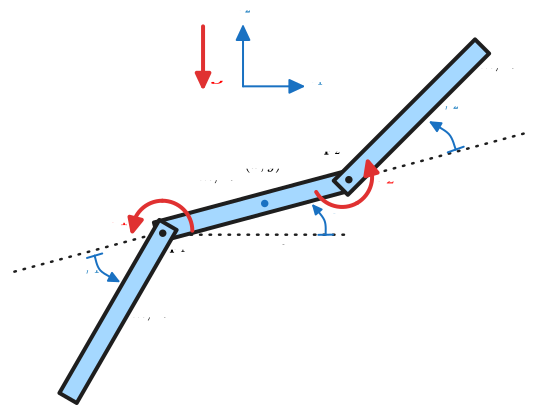
We are given a three-link robot connected by two actuated joints with the following generalized coordinates:
Figure HW1.1: Given robot.
Gravity acts along and torques command the relative angles while orients the middle link centered at . The links are identical slender rods of length and mass , with uniform mass distribution and central moment of inertia .
Assignment 1
Write expressions for components of the robot’s total center of mass position depending on coordinates , and of velocities depending on . Explain.
Solution:
The total mass position depends on the center of mass of the three links (equally, as they are all the same mass):
Taking the total time derivative of and yields the centroid velocity components:
The terms proportional to capture the symmetric contributions of links and relative to the actuated joint angles, whereas track the translational motion of the middle link.
Assignment 2
Write expression for the robot’s total angular momentum about its center of mass , a scalar component in direction, Arrange it in the form
Solution:
Total angular momentum about center of mass is given by:
where the notation is the position of link relative to the total center of mass:
Since all links share the same mass and , the translational parts depend only on the relative vectors while the rotational part adds , , . Collecting terms and eliminating the body translation (which cancels because ) gives:
Therefore:
Assignment 3
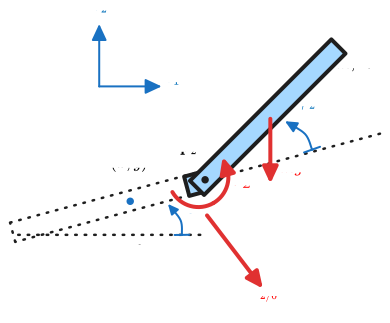
Draw forces and torques diagram for link (the rightmost). Write a scalar equation for balance of the link’s angular momentum about the joint position . The equation should include terms depending on , gravity force and joint toque , but no internal reaction forces.
Solution:
Figure HW1.2: Forces and torques diagram for link . is the equivalent force that link exerts on link at the joint (in a arbitrary direction).
The angular momentum balance for the moving joint must include the inertial term:
Where the inertial term accounts for the acceleration of the reference point.
The joint position is
and the link- center of mass is
so that
Differentiating gives the absolute velocity of the link- center of mass:
The required cross product for angular momentum calculation:
The total angular momentum about the moving joint is then
External torques about consist of the applied motor torque and the gravitational moment:
Write the robot’s dynamic equation of motion using Lagrange’s formulation, and arrange in matrix form. Explain all stages of derivation.
Solution:
Using symbolic calculations in MATLAB, the kinetic and potential energies are:
Evaluating these sums yields
with , , . The Lagrangian produces Euler–Lagrange equations that can be written in compact matrix form as
where , .
Splitting the coordinates into body and shape sets,
produces the block partitions needed for the under-actuated structure as presented in the lecture with equation (1.2):
Where, from the Lagrangian , we can write:
and are the actuation torques extracted once the prescribed shape accelerations are known.
Assignment 5
Physical values are given as . At the initial time , the robot is released from rest in horizontal posture, , The joint angles are prescribed in time as $$
\begin{aligned}
& {\phi}{1}(t)=S(t)[-\alpha+\beta \sin(\omega t-\psi)] \[1ex]
& {\phi}{2}(t)=S(t)[\alpha +\beta \sin(\omega t+\psi)]
\end{aligned}
Present graphs of the following time plots: ## Figure a Angle of middle link $\theta(t)$, in degrees. **Solution**: The full five-state model was integrated in MATLAB with `ode45` over $0\leq t\leq \pu{40s}$ using $\Delta t=\pu{0.001s}$. The prescribed joint angles excite the middle link and reorient it. ![[HDY1_HW001_PartA.png|bookhue|600]]^figure-hw1-part-a >Middle-link angle $\theta(t)$ in degrees. (Self-generated simulation.) The motion remains bounded because angular momentum is internally redistributed by the joint actuation while the total center of mass stays fixed. <div><hr><hr></div> ## Figure b Normalized horizontal position of the middle link's center $x(t)/\ell$, overlaid with the center of mass position ${x}_{c}(t)/\ell$, on the same plot. Explain the results. **Solution**: ![[HDY1_HW001_PartB.png|bookhue|600]]^figure-hw1-part-b >Normalized horizontal positions $x/\ell$ and $x_{c}/\ell$. (Self-generated simulation.) [[#^figure-hw1-part-b|Figure]] highlights that link $0$'s geometric center translates significantly even though the overall center of mass hardly moves. This satisfies linear-momentum conservation for the system. <div><hr><hr></div> ## Figure c Normalized horizontal velocity of the middle link's center $\dot{x}(t)/(\ell\omega)$, overlaid with the center of mass horizontal velocity $\dot{x}_{c}(t)/(\ell\omega)$, and the normalized total angular momentum ${H}_{c}(t)/(m\ell ^{2}\omega)$, all on the same plot. Explain the results. **Solution**: ![[HDY1_HW001_PartC.png|bookhue|600]]^figure-hw1-part-c >Normalized horizontal velocities and angular momentum. (Self-generated simulation.) [[#^figure-hw1-part-c|figure]] shows that $\dot{x}_{c}$ and $H_{c}/(m\ell^{2}\omega)$ remain effectively zero. Internal actuation therefore reshapes the body without accumulating horizontal translation or global angular momentum. $\dot{x}$ on the other hand, is link $0$'s center of mass horizontal position, and it is free to change as long as the center of mass remains zero. <div><hr><hr></div> ## Figure d Normalized horizontal velocity of the middle link's center $\dot{y}(t)/(\ell\omega)$, overlaid with the center of mass horizontal velocity $\dot{y}_{c}(t)/(\ell\omega)$, on the same plot. Add another graph of the difference $[\dot{y}(t)-\dot{y}_{c}(t)]/(\ell\omega)$. Explain the results. **Solution**: ![[HDY1_HW001_PartD.png|bookhue|600]]^figure-hw1-part-d >Vertical velocity comparison (top) and normalized difference (bottom). (Self-generated simulation.) [[#^figure-hw1-part-d|Figure]] shows the robot’s total center of mass follows link $0$'s vertical motion extremely closely. The deviations mainly occur because of the phase difference applied to the actuated joints. These effect the vertical velocities of joints $1$ and $2$ with a slight delay between them, therefore the total center of mass deviates slightly from link $0$'s vertical velocity. <div><hr><hr></div> ## Figure e Normalized angular velocity of the middle link $\dot{\theta}(t)/\omega$. Add on the same plot a curve where $\dot{\theta}(t)$ is calculated from conservation of total angular momentum ${H}_{c}(t)=0$ using the expression from assignment 2 above. Compare and explain the results. **Solution**: ![[HDY1_HW001_PartE.png|bookhue|600]]^figure-hw1-part-e >Measured vs. momentum-inferred angular velocity. (Self-generated simulation.) The two curves are visually indistinguishable, so the symbolic decomposition $H_{c}=f_{0}\dot{\theta}+f_{1}\dot{\phi}_{1}+f_{2}\dot{\phi}_{2}$ matches the numerical trajectory. <div><hr><hr></div> ## Figure f Actuation torques at the joints, ${\tau}_{1}(t),\,{\tau}_{2}(t)$, two curves on the same plot. **Solution**: ![[HDY1_HW001_PartF.png|bookhue|600]]^figure-hw1-part-f >Joint torques over time. (Self-generated simulation.) The opposite phasing reflects the mirrored excitation applied to $\phi_{1}$ and $\phi_{2}$. <div><hr><hr></div> ## Figure g Normalized angular acceleration of the middle link $\ddot{\theta}(t)/\omega ^{2}$. Add on the same plot a curve where $\ddot{\theta}(t)$ is calculated from balance of angular momentum for link 2 derived in assignment 3 above. Compare and explain the results. **Solution**: ![[HDY1_HW001_PartG.png|bookhue|600]]^figure-hw1-part-g >Angular accelerations from the full-state integration vs. the link-2 balance. (Self-generated simulation.) The direct output $\ddot{\theta}/\omega^{2}$ matches the reconstruction based on the link $2$ balance, confirming the consistency of the derived dynamic model. # Assignment 6 Write a short paragraph (3-6 sentences) of summary and conclusions from this exercise. **Solution**: The simulation demonstrates how internal shape changes can reorient the system while preserving the zero-mean center of mass position. Since the input profiles are smooth ($C^2$), the required torques remain small ($\pm 0.02\,\mathrm{N\cdot m}$), suggesting this maneuver is physically feasible. The numerical results align perfectly with the symbolic derivations for position and angular momentum, and the link-$2$ momentum balance confirms the dynamic consistency of the model.