
Introduction to Robotics (035001) | Spring Semester 2025
| Ido Fang Bentov | Nir Karl | Ofir Rubin |
|---|---|---|
| CLASSIFIED | CLASSIFIED | CLASSIFIED |
| CLASSIFIED | CLASSIFIED | CLASSIFIED |
Problem Description
An industrial 6-DOF Universal Robots UR5e manipulator is deployed in a door manufacturing facility to paint decorative triangular shapes on doors moving on a conveyor belt. The robot holds a
The doors arrive vertically on a conveyor belt moving at a constant velocity of
Key Assumptions
- Each robot link weighs
- Paint sprayer nozzle remains perpendicular to the door at all times
- UR5e specifications are used for all kinematic and dynamic constraints
Assignment Solutions
Assignment 1: Robot Placement
We positioned the robot base at the origin of the world coordinate system:
The door surface is positioned at
The triangle is positioned with its bottom center at
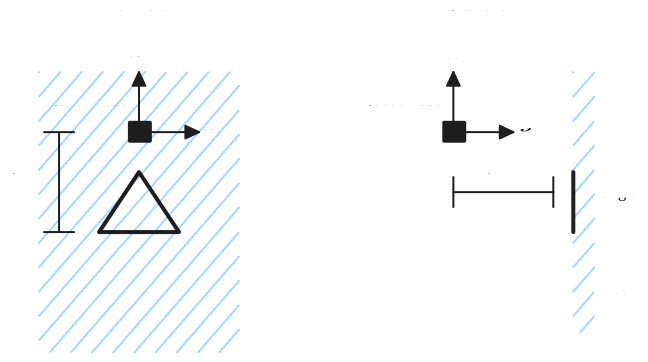
Figure P1.1: Robot placement schematic showing the coordinate system, robot base at origin, door surface at
, and triangle positioned with bottom center at .
Reach Verification:
The maximum reach occurs at the triangle’s top vertex when the door is at maximum X displacement. The top vertex is at:
Maximum reach distance:
This is well within the robot’s maximum reach (
Justification:
- The door at
- The triangle’s vertical position (
- All via-points remain within reach despite conveyor motion with
- The configuration avoids singularities in the primary working region

Figure P1.2: Triangle trajectory visualization showing the 3D path (left) and XZ projection (right). The path accounts for conveyor motion during painting.
Assignment 2: Via-Points Trajectory
Triangle Geometry:
For an equilateral triangle with
- Vertex 1 (top):
- Vertex 2 (bottom right):
- Vertex 3 (bottom left):
Via-Point Generation Strategy:
We generated
- Approximately 100 points per side
- Path order: V1 → V2 → V3 → V1 (closed loop)
- Sampling interval:
Conveyor Synchronization:
The critical challenge is that the door moves
At each via-point
This approach keeps the end-effector X-coordinate range within
Position Accuracy:
The total expected position error has three main sources:
-
Via-point discretization: With
$$
\delta \approx \frac{s^2}{8R} \approx \frac{(0.004)^2}{8 \times 0.4} \approx 5 \times 10^{-6},\pu{m} \approx \pu{0.005mm} -
IK convergence tolerance: The inverse kinematics solver converges when position error
-
Robot repeatability: The UR5e specification is
Total expected error: Combining these sources, we expect maximum position errors:
This is acceptable for the painting application where the spray pattern width (
Assignment 3: Forward Kinematics
We implemented forward kinematics using the Denavit-Hartenberg (DH) convention. For the UR5e, the DH parameters are:
| Joint | ||||
|---|---|---|---|---|
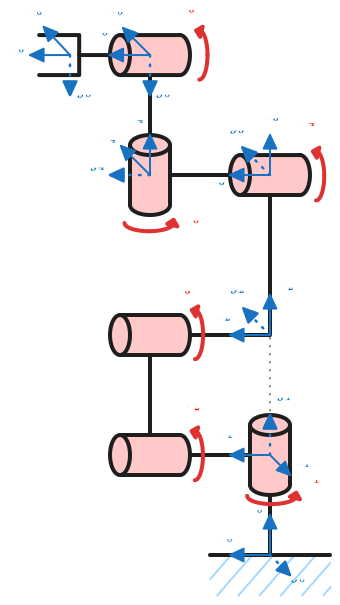
UR5e robot coordinate frames according to the Denavit-Hartenberg convention, showing the placement of each joint frame and the corresponding link parameters.
The transformation matrix from frame
The forward kinematics provides the end-effector position and orientation:
Implementation:
The function forward_kinematics(theta, robot) computes this transformation for any given joint configuration
function [T, T_all] = forward_kinematics(theta, robot)
	% Initialize transformation matrices
	T_all = cell(1, 6);
	T = eye(4);

	% Compute each joint transformation
	for i = 1:6
		Ti = dh_matrix(robot.a(i), robot.alpha(i), robot.d(i), theta(i));
		T = T * Ti;
		T_all{i} = T;
	end
end

function T = dh_matrix(a, alpha, d, theta)
	% DH transformation matrix
	T = [cos(theta), -sin(theta)*cos(alpha),  sin(theta)*sin(alpha), a*cos(theta);
		 sin(theta),  cos(theta)*cos(alpha), -cos(theta)*sin(alpha), a*sin(theta);
		 0,		   sin(alpha),			  cos(alpha),			d;
		 0,		   0,					   0,					 1];
end
Symbolic Representation:
The complete transformation from base to end-effector can be expressed symbolically as:
where each
Assignment 4: Inverse Kinematics
The inverse kinematics problem requires finding joint angles
Analytical Approach:
For 6-DOF manipulators like the UR5e with a spherical wrist, we can decouple the problem:
- Position problem (joints 1-3): Determine wrist center position
- Orientation problem (joints 4-6): Determine wrist angles
The wrist center position is:
For a 6-DOF manipulator, up to 8 analytical solutions may exist due to:
- Joint 1: 2 solutions (elbow left/right)
- Joint 2-3: 2 solutions (elbow up/down)
- Joint 5: 2 solutions (wrist flip)
Solution Selection with Collision Avoidance:
We implement a constraint-based filtering approach with collision avoidance:
-
Joint Angle Limits: Enforce practical joint limits to avoid extreme configurations
- Joint 2:
- Joint 3:
- Joint 2:
-
Collision Constraints: All joint positions must satisfy:
- Door constraint:
- Floor constraint:
- Nozzle distance:
- Door constraint:
-
Selection: From all collision-free solutions, select the one minimizing:
$$
\text{cost} = 1000 \cdot |\mathbf{p}{\text{achieved}} - \mathbf{p}{\text{desired}}|^{2} + 0.01 \cdot |\boldsymbol{\theta} - \boldsymbol{\theta}_{\text{current}}|^{2}
Verification:
For each via-point, we verify the solution by computing forward kinematics and checking position error:
Implementation:
function [theta_all, theta_best] = inverse_kinematics(T_desired, theta_current, robot, door_y, floor_z)
	% Extract desired position and orientation
	p_desired = T_desired(1:3, 4);
	R_desired = T_desired(1:3, 1:3);

	% Joint limits with practical constraints
	lb = -2*pi * ones(6,1);
	ub = 2*pi * ones(6,1);
	lb(2) = -3*pi/4; ub(2) = pi/4;   % Shoulder range
	lb(3) = -pi/6;   ub(3) = 5*pi/6; % Elbow range

	% Fix joint 6 for consistent orientation
	theta6_fixed = 0;
	Aeq = [0 0 0 0 0 1];
	beq = theta6_fixed;

	% Cost function: prioritize position accuracy, penalize large joint motion
	cost_function = @(theta) 1000*norm(forward_kinematics(theta, robot)(1:3,4) - p_desired)^2 ...
							+ 0.01*norm(theta - theta_current)^2;

	% Nonlinear collision constraints
	nonlcon = @(theta) collision_constraints(theta, robot, door_y, floor_z);

	% Optimization options
	options = optimoptions('fmincon', 'Display', 'off', 'Algorithm', 'sqp', ...
						  'MaxFunctionEvaluations', 5000);

	% Try multiple initial guesses
	initial_guesses = [theta_current, zeros(6,1), [0;-pi/4;pi/2;0;pi/2;0]];
	theta_all = [];
	for k = 1:size(initial_guesses, 2)
		theta0 = initial_guesses(:, k);
		[theta_sol, ~] = fmincon(cost_function, theta0, [], [], Aeq, beq, lb, ub, nonlcon, options);

		% Verify solution
		[c, ~] = collision_constraints(theta_sol, robot, door_y, floor_z);
		pos_error = norm(forward_kinematics(theta_sol, robot)(1:3,4) - p_desired);
if pos_error < 0.0002 && all(c <= 0) % 0.2mm tolerance
theta_all = [theta_all, theta_sol];
end
end
% Select best solution (smallest joint displacement)
if ~isempty(theta_all)
[~, idx] = min(vecnorm(theta_all - theta_current));
theta_best = theta_all(:, idx);
else
theta_best = theta_current; % Fallback
end
end
function [c, ceq] = collision_constraints(theta, robot, door_y, floor_z)
% Compute all joint positions
[~, T_all] = forward_kinematics(theta, robot);
joint_positions = zeros(3, 7);
joint_positions(:, 1) = [0; 0; 0];
for i = 1:6
joint_positions(:, i+1) = T_all{i}(1:3, 4);
end
safety_margin = 0.03; % 3 cm clearance
c = [];
% Door constraint: Y_joint < door_y - safety_margin
for i = 1:7
c = [c; joint_positions(2, i) - (door_y - safety_margin)];
end
% Floor constraint: Z_joint > floor_z + safety_margin
for i = 1:7
c = [c; (floor_z + safety_margin) - joint_positions(3, i)];
end
% Lateral limits: -1m < X < 1m
for i = 2:7
c = [c; joint_positions(1, i) - 1.0];
c = [c; -1.0 - joint_positions(1, i)];
end
% End-effector Y constraint: 0.2m <= Y_ee <= 0.35m
ee_pos = joint_positions(:, 7);
c = [c; (door_y - 0.2) - ee_pos(2)];
c = [c; ee_pos(2) - (door_y - 0.05)];
ceq = [];
endAssignment 5: Jacobian Matrix
The Jacobian matrix relates joint velocities to end-effector velocities:
where
Geometric Jacobian Formulation:
For each joint
For revolute joints:
where:
The full Jacobian is:
Implementation:
The function compute_jacobian(theta, robot) returns both the full 6×6 Jacobian and the upper 3×6 linear velocity Jacobian for singularity analysis.
The Jacobian
where
Numerical Implementation:
function [J, J_linear] = compute_jacobian(theta, robot)
	% Compute forward kinematics for all joints
	[~, T_all] = forward_kinematics(theta, robot);

	% Initialize Jacobian matrices
	J = zeros(6, 6);

	% End-effector position
	p_ee = T_all{6}(1:3, 4);

	% For each joint
	for i = 1:6
		if i == 1
			z_prev = [0; 0; 1];  % Base z-axis
			p_prev = [0; 0; 0];   % Base position
		else
			z_prev = T_all{i-1}(1:3, 3);  % Joint axis direction
			p_prev = T_all{i-1}(1:3, 4);   % Joint position
		end

		% Linear velocity component: J_v = z × (p_ee - p_joint)
		J(1:3, i) = cross(z_prev, p_ee - p_prev);

		% Angular velocity component: J_ω = z
		J(4:6, i) = z_prev;
	end

	% Extract linear velocity Jacobian (upper 3 rows)
	J_linear = J(1:3, :);
end
Assignment 6: Singularities
Singularities occur when
Singularity Analysis Method:
To identify singularities systematically, we analyze the linear velocity Jacobian
A singularity occurs when these six vectors become linearly dependent (only three independent directions remain). We identify three primary cases:
-
Wrist singularity: When
-
Shoulder singularity: When
-
Elbow singularity: When joints 2 and 3 are collinear (
Workspace Visualization:

Figure P1.3: 3D workspace visualization showing the reachable positions of the end-effector. The point cloud represents sampled configurations within the robot’s operational range.
Singularity Avoidance in Our Task:
Our trajectory planning successfully avoids all singularities by:
- Maintaining
- Keeping the wrist center away from the base Z-axis
- Operating well within the extended/folded limits
Assignment 7: Trajectory Planning
7a) Polynomial Selection:
We use cubic spline interpolation with optimized boundary conditions for smooth trajectories. MATLAB’s spline function creates piecewise cubic polynomials with
For each joint, the spline is defined with zero endpoint velocities:
This creates a smooth trajectory that:
- Passes through all via-points exactly
- Has continuous position, velocity, and acceleration
- Starts and ends with zero velocity (as required)
- Minimizes acceleration discontinuities
Why Cubic Splines:
Cubic splines provide an excellent balance between:
- Smoothness:
- Computational efficiency: Closed-form solution, no optimization required
- Stability: Well-conditioned numerical properties
- Flexibility: Natural interpolation through densely-spaced via-points (
7b) Time Interval:
As specified, we use
7c) Velocity Constraint Verification:
UR5e maximum joint velocities:
Our trajectory maximum velocities achieved (3-second trajectory):
| Joint | Max Velocity (deg/s) | Limit (deg/s) | Status |
|---|---|---|---|
| ✓ | |||
| ✓ | |||
| ✓ | |||
| ✓ | |||
| ✓ | |||
| ✓ |
7d) Timing Requirement:
We selected
Results and Verification
Constraint Verification Summary
Joint Torques (with
| Joint | Max Torque ( |
|---|---|
Note on Joint Torques:
- Joint 1 shows
- Joint 6 shows
- Joint 2 (shoulder) has the highest torque requirement as it supports the entire arm weight plus payload against gravity with a large moment arm.

Figure P1.4: Joint position trajectories showing smooth motion profiles for all six joints throughout the 3-second painting cycle.

Figure P1.5: Joint velocity profiles with maximum velocity indicators (red stars) and velocity limits (red dashed lines). All velocities remain well within specifications.

Figure P1.6: Static joint torques computed for
payload, showing maximum torque requirements at each joint.

Figure P1.7: 3D end-effector trajectory showing the triangular paint path in the robot’s workspace, with coordinate frame and door surface representation.

Figure P1.8: Robot configurations at key time points during the painting trajectory: start (left), midpoint (center), and end (right). The visualization shows the robot’s pose and end-effector position throughout the task.