
Point Particle - 1D Impact
Compliant Contact Model
Consider a particle with a single DOF
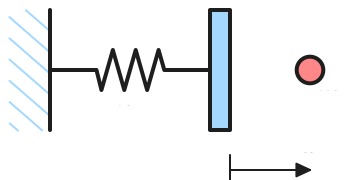
Figure 5.1: Compliant contact model for 1D impact.
The equation of motion during contact is piecewise-defined:
At the collision time
For
Applying initial conditions
- From
- From
Therefore:
where the maximal deformation is:
This result has a clear physical interpretation: higher mass or velocity leads to deeper penetration, while higher stiffness reduces penetration.
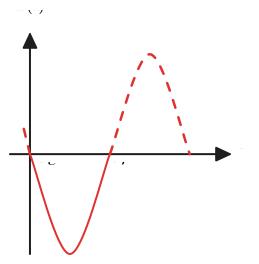
Figure 5.2: Full elastic contact.
The contact ends at the release time
The velocity at release is:
For a purely elastic spring with no damping, the particle rebounds with the same speed it had before impact.
The maximum contact force occurs at maximum deformation:
In the limit of rigid bodies,
- Contact duration:
- Deformation:
- Contact force:
However, the velocity jump is finite:
For instantaneous collisions, we use the impulse-momentum relation:
where
This is the key insight for rigid-body impact: we work with impulses rather than forces.
Kelvin-Voigt Contact Model
When adding a damper in parallel with the spring, we obtain the Kelvin-Voigt model:
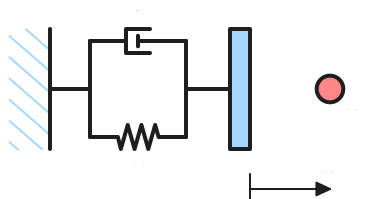
Figure 5.3: Kelvin-Voigt contact model with spring and damper in parallel.
With initial conditions
For
where
The general solution is:
Applying initial conditions:
- From
- From
Therefore:
The velocity is:
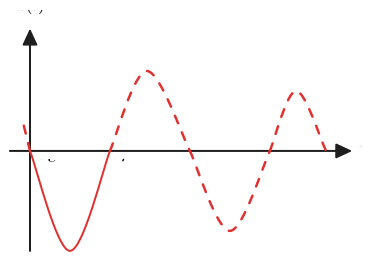
Figure 5.4: Underdamped case.
A subtle issue arises when defining the release time
- Kinematic definition:
- Dynamic definition:
For the Kelvin-Voigt model, these two definitions are inconsistent:
- If we define
$$
f({t}{r})=-kx({t}{r})-c\dot{x}({t}{r})=-c\dot{x}({t}{r})<0 - If we define
$$
0=-kx({t}{r})-c\dot{x}({t}{r}) \implies x({t}{r})=-\dfrac{c}{k}\dot{x}({t}{r})<0
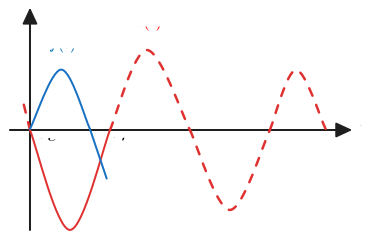
Comparison of kinematic and dynamic release conditions for Kelvin-Voigt model.
Using the kinematic definition
Therefore:
The velocity at release from equation (5.10):
The coefficient of restitution is:
This elegant result shows that
- For
- For
Hunt-Crossley Nonlinear Contact Model
The inconsistency in release conditions for the Kelvin-Voigt model motivates Hunt-Crossley’s nonlinear force law:
For Hertzian contact theory,
This model resolves the release time issue: when
Advantages:
- Consistent release conditions:
- More physically realistic for contact between curved surfaces
Disadvantages:
- Nonlinear dependence on initial velocity
- No closed-form analytic expression for
For practical applications, numerical integration is typically required to determine the coefficient of restitution.
Lagrangian Formulation of Frictionless Impact
General Framework
Consider a multi-body system with
where
Collision occurs at time
During collision, the constrained Lagrange equations are:
Velocity Jump Equation
For an instantaneous collision (
Key assumptions for
- No configuration change:
- Constant matrices:
- Impulsive force dominance: In the rigid-body limit
Under these assumptions:
where
Restitution Law
The coefficient of restitution relates pre- and post-impact normal velocities:
In matrix form:
Substituting equation (5.15):
Solving for the impulse:
Since
Impact Map
Substituting
Defining the impact map matrix:
We obtain the compact form:
Example: Falling / Bouncing Rod
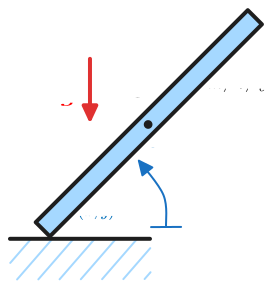
Consider a rod of mass
, length , and moment of inertia about its center of mass. The rod makes frictionless contact with a horizontal surface at one endpoint.
Figure 5.5: Bouncing rod configuration with contact at endpoint.
Coordinate System: We define
as the position of the contact point and as the rod angle. Thus . Constraint: The contact distance is
, giving: Kinematics: The center of mass position and velocity are:
Energies:
Mass Matrix:
Inverse Mass Matrix (required for impulse calculation):
The relevant quantity is. Using the formula for the inverse of a matrix and extracting the element: Contact Impulse: From equation (5.17):
Post-Impact Velocities: Applying the impact map:
Conservation of Horizontal COM Velocity:
Looking at the result for
(simple restitution in normal direction), we can prove that the horizontal velocity of the center of mass is conserved: To show this, we substitute the post-impact velocities:
This result follows from the fact that the impulsive force acts purely in the normal direction (frictionless contact), and therefore cannot change the horizontal component of linear momentum. The quantity
is precisely the horizontal velocity of the center of mass. Plastic Collision (
): For
, we get , but and . This means not all kinetic energy vanishes in a plastic collision - only the normal component of velocity at the contact point is arrested. The rod continues to move horizontally and rotate.
Hybrid Dynamical Systems
Definition
A hybrid system (HS) for state
Often, the jump set
Solutions of Hybrid Systems
A solution of a hybrid system consists of:
- A continuous trajectory
- A sequence of jump times
such that:
- Between jumps:
- At jumps:
Mechanical Systems as Hybrid Systems
For mechanical systems with state
Guard (jump set):
Reset/jump map for frictionless impact:
For frictional impact, the reset map may have multiple branches:
Example: Zeno's Paradox - The Bouncing Ball
A remarkable property of hybrid systems is that they may have infinitely many jump times
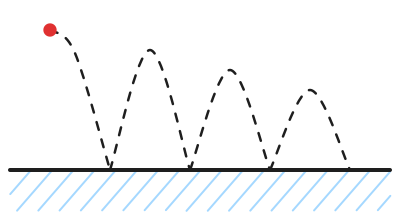
, , all accumulating in a finite amount of time. This phenomenon is known as Zeno’s paradox (named after the Greek philosopher Zeno of Elea). Consider a bouncing ball with coordinates
:
Figure 5.6: Bouncing ball undergoing repeated impacts.
Flow dynamics (for
): Jump (when
and ): where
. Analysis: For initial state
and : First flight (
): Setting
: First impact:
Second flight (
): Setting
gives a quadratic with positive root: At the second impact:
This follows from energy conservation during free flight: the ball reaches the same speed when returning to the ground as it had when leaving.
Second impact:
Recursive Pattern: The recursive law is:
which is a decaying geometric series.
Time gaps between impacts:
Peak heights:
This is because the maximum height is reached when all kinetic energy converts to potential energy:
. Finite Accumulation Time:
Limiting cases:
- As
(plastic): (single impact) - As
(elastic): (infinite bouncing time) What happens for
? At the accumulation time, we have:
The ball comes to rest on the surface. For
, the system transitions to constrained motion (persistent contact) with .
Impact with Friction and Slippage
Point Particle Impact in 2D
Consider a point particle colliding with a surface where friction is present. The relative velocity and impulse vectors are decomposed into tangential and normal components:
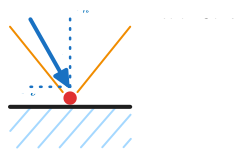
General impact configuration with friction showing tangential and normal directions.
Relative velocity vector:
Impulse vector:
Impulse-momentum balance:
For given pre-impact velocity
In the normal direction, we apply the standard restitution law:
By analogy, one might suggest a tangential restitution law:
But what is the valid range of
The change in kinetic energy is:
For physical consistency, we require
Is
The friction bound on impulses is:
This is justified because
From the impulse-momentum relations:
Substituting into the friction bound:
Special case
This means that the negative of the incoming velocity
General case
This defines a different cone, scaled by the ratio of restitution factors.
Problem: For shallow collision angles (large
Naive Impact Law with Friction
A simpler approach assumes:
- Normal direction:
- Tangential direction:
Consider
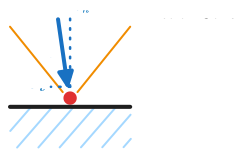
Figure 5.7: Almost vertical impact
Impulses:
Post-impact velocities:
Energy change:
Taking
Unphysical result: For
Why did this happen? We assumed
Corrected Model: Impact as a Process
The key insight is that collision is a process occurring over some fast time interval
Impulses accumulate in time:
Velocities evolve:
Tangential force follows instantaneous Coulomb law:
We analyze the impact process in the
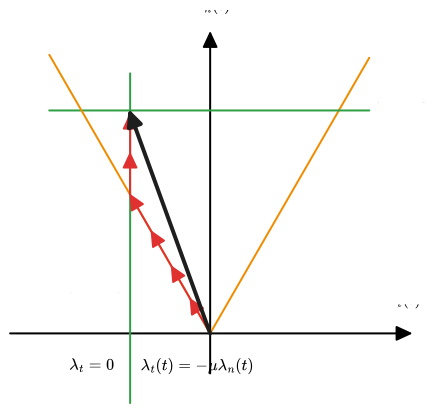
Impact analysis in the
impulse plane showing the s-line, t-line, and friction cone constraints.
Initial conditions:
Key lines in the impulse plane:
-
S-line (sticking line): The locus where
-
T-line (termination line): The locus where
Impact trajectory in the impulse plane:
During slipping with
The trajectory moves along a line of slope
Case 1: Sticking before termination - If the trajectory reaches the s-line before the t-line:
- Phase 1 (slipping): Follow slope
- Phase 2 (sticking): Move vertically (
Case 2: Termination before sticking - If the trajectory reaches the t-line first:
- Only slipping phase along slope
Case 3: Velocity reversal - For shallow angles, the trajectory may:
- First slip with
- Reach
- Continue slipping with
Total impulse: The final impulse
Chatterjee’s Algebraic Law
Chatterjee proposed a simple algebraic law that captures the essential physics without tracking the full impulse trajectory.
Algorithm:
-
Compute candidate impulse
-
Check friction feasibility: If
-
Otherwise, project onto friction cone: If the candidate impulse violates friction bounds:
The result is:
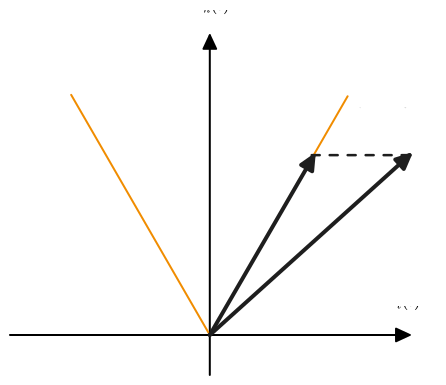
Chatterjee’s algebraic law: the candidate impulse
is projected onto the friction cone when it violates friction bounds.
Energy consistency: One can verify that this law always satisfies
Lagrangian Formulation of Impact with Friction (2D)
General Framework
Consider a multi-body system with coordinates
- Normal velocity:
- Tangential velocity:
Combining these into vector form:
The impulse vector is:
Impulse-Momentum Relation
The velocity jump is:
The contact velocity jump is:
where the collision matrix is:
This is a
Example: Single Rigid Body Impact
Consider a rigid body with mass
, moment of inertia , and radius of gyration (so ).
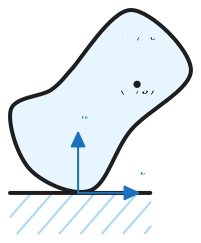
Figure 5.8: Single rigid body impact configuration.
is the contact point, is the center of mass. Coordinates:
where is the position of the center of mass . The contact point
is located at relative to . Contact velocities: The velocity of point P is:
Expanding the cross product (with frame
aligned with contact directions): Therefore:
Constraint matrix:
Mass matrix: For a rigid body with COM at
: Collision matrix:
Physical interpretation:
- Diagonal terms
and represent “effective inverse masses” for tangential and normal impulse response - Off-diagonal term
represents coupling between tangential impulse and normal velocity change (and vice versa) Special case:
or - The collision matrix becomes diagonal, and there is no coupling between tangential and normal directions.
Fully-Plastic Impact Law
For fully-plastic impact (
From
The generalized velocity jump is:
Substituting
Energy Balance with Friction
The kinetic energy change is:
Substituting
Using
For fully-plastic impact with
Since
What about friction constraints
? And nonzero restitution with ? These require more sophisticated treatment - either the impulse plane analysis described earlier, or advanced methods like Routh’s graphical method, which handles the interplay between friction and restitution during the impact process.
Detailed Algebraic Impact Law (Chatterjee)
Consider a general Lagrangian system where the velocity jump is governed by the collision matrix
where
We define two reference impulse vectors:
-
Frictionless impulse
-
Completely plastic impulse
We construct a candidate impulse
This candidate impulse satisfies the kinematic restitution laws:
Note:
The tangential part holds strictly only if
is diagonal or ).
Friction-Bounded Impulse
To satisfy Coulomb’s friction bound
where the coefficient
Geometric Interpretation:
- If the candidate impulse
- If not, we project
This formulation ensures energy consistency (
Routh’s Graphical Method for General Systems
Routh’s method treats impact as a continuous process in the impulse plane
Process Evolution
During the collision interval
or in components:
Key Lines in the Impulse Plane
We identify specific lines in the
-
Line of Full Compression (
Crossing this line marks the transition from the compression phase (
-
Line of Sticking (
On this line, the contact point sticks.
-
Friction Cone Edges: defined by
-
Termination Line (
- Newton’s (Kinematic) Restitution:
- Poisson’s (Impulse) Restitution: Defined by the ratio of impulses during restitution and compression phases:
- Stronge’s (Energetic) Restitution: Ratio of work done during restitution to work done during compression. Used when energy consistency is critical in complex systems.
- Poisson’s (Impulse) Restitution: Defined by the ratio of impulses during restitution and compression phases:
- Newton’s (Kinematic) Restitution:
Newton vs. Poisson
For a point particle (diagonal
), Newton and Poisson definitions are equivalent. For coupled systems ( ), they differ. Poisson’s definition guarantees energy consistency ( ), while Newton’s may occasionally violate it for certain parameters.
Algorithm for Impulse Accumulation
To solve the impact problem graphically or numerically:
- Start at origin:
- Determine initial slip direction: Check
- March upwards (increasing
- If slipping (
- If sticking (
- If slipping (
- Monitor crossings:
- If
- If
- If
- Terminate:
- Stop when the Total Normal Impulse reaches the value defined by the termination line (e.g.,
- Stop when the Total Normal Impulse reaches the value defined by the termination line (e.g.,
- Result: The point reached in the plane gives the final impulse
This method resolves paradoxes like Painlevé’s paradox (where rigid body dynamics equations have no solution or non-unique solutions), by treating impact as a proper evolution process.
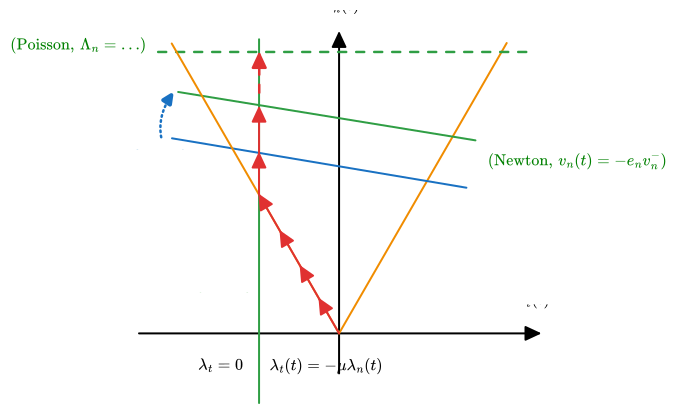
Figure 5.9: Routh method for rigid body impact.