
Dynamics with a Single Unilateral Frictionless Contact
Consider a mechanical system of rigid bodies (robot / mechanism with links and joint) subject to a single unilateral contact constraint. The system’s unconstrained (redundant) coordinates are
When the system moves while keeping persistent contact
Where
We now prove that the physical meaning of
The second term is identically zero. To see why, note that since
Therefore, the generalized force associated with the constraint is
In the case of a unilateral contact, the normal force must be non-negative
The contact state changes to separation - unconstrained motion. The equations of motion for
Does equation
completely describe the system's dynamic behavior? No! Although this equation can describe the transition from contact to separation, it does not describe the transition from separation to contact. In the transition from separation to contact may, and probably will, include impact, which will actually jump us to a different place in the state space. That is hybrid dynamics. At the time
of this transition we have . In order to avoid inter-penetration between rigid bodies there must be a jump in in order to enforce in order to prevent rigid-body penetration (Rigid-body impacts will be covered later). The system’s behavior can be best described by a graph of state transitions:
Figure 4.1: State transition graph.
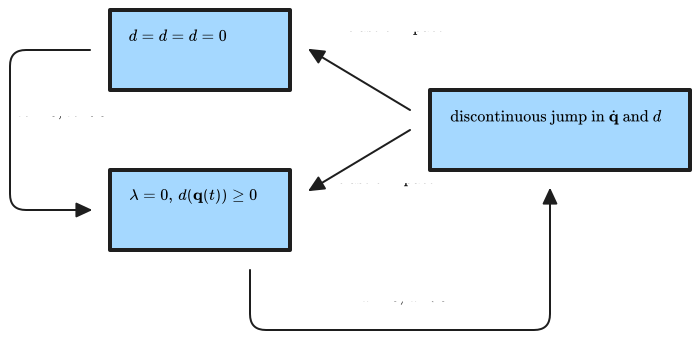
Is the state transition "contact to separation" at
well defined? That is, for times
, does the solution satisfy ? Is it possible that penetration occurs, i.e. ?
Right before separation (), we have . We know that changes continuously at time , so that . But jumps such that and . From (4.1), this implies that also changes continuously at , so that . But what about the third order, ? Since the inertia matrix
is positive (semi-) definite, we know that . Defining , from (4.2) and (4.3) we obtain that and . Time-derivatives of the distance are obtained at and . During separation for one can substitute into (4.2) to obtain . This precisely gives that . Therefore, one obtains that , so that separation indeed continues. Answer: The state transition “contact to separation” at
is well defined.
Dynamics with a No-Slip Contact (with unbounded/sufficiently large friction)
The system’s unconstrained coordinates
Example: Wheel on ground in 2D
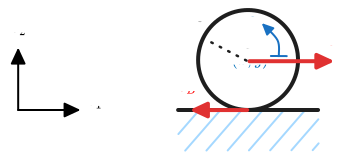
Given below is a simple case of a wheel rolling on the ground with a no-slip constraint:
Figure 4.2: Wheel on ground in 2D.
Defining our coordinates as
, our holonomic constraint is . The holonomic is a row vector: The absolute velocity of the point contact is:
The non-holonomic constraint as a result of the no-slip constraint is:
Therefore:
We know we can write the equations of motion in the form of equation (2.12):
When the system moves while keeping persistent no-slip contact, the constraint dynamic equations are:
The constraint force vector is composed as
It is sometimes tempting to assume “ideal no-slip contact”, without any transition to slippage, just to separation. This is equivalent to assuming “infinite friction”, so that slippage is ignored, assuming that crossing
The Falling Pencil Problem
Based on “Wobbling, toppling, and forces of contact”^[McGeer, T., & Palmer, L. H. (1989). Wobbling, toppling, and forces of contact. American Journal of Physics, 57(12), 1089–1098.].
The figure below shows a slender rod having mass
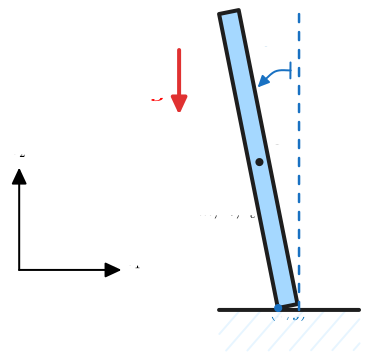
Figure 4.3: Falling pencil system.
At the initial time, the rod is in upright (unstable) position
First, we choose the vector of generalized coordinates
and:
Next, we derive the constrained dynamic equations by formulating the kinetic and potential energies under constraint-free motion (even though the constrained motion has 1-DOF).
Center-of-mass position and velocity vector:
The energies:
From this, we obtain Lagrange’s equations of constrained motion (equation (4.5)):
where:
Substituting the time-derivates of the constraints
Substituting the time-derivates of the constraints
We now isolate the acceleration
Multiplying (4.7) by
This is precisely the conservation of total mechanical energy
From (4.10), we can isolate
At the initial time we have from (4.11) that
where
Note that the nondimensional mass distribution parameter
- Point mass concentrated at the rod’s center -
- Uniform mass distribution -
- Symmetric point masses at the rod’s ends -
Substituting
Thus, from (4.12) we find that for
In fact, if we increase initial velocity
Note that unlike the case of frictionless contact, the accelerations
It can be proven that
The obvious way to resolve this paradox is to consider a finite coefficient of friction, and transition to slippage when the constraint
For a better explanation, watch the following talk.
Dynamics with a Slipping Contact
In the case of a slipping contact, due to Coulomb’s law for slipping (if we are assuming Coulomb friction), we can define
Plugging into (4.6):
Assuming
Differentiating normal constraint
substituting into the expression for
Rearranging:
Which allows us to write:
The physical meaning of
But, what happens if
For the frictionless case
For example, the the slipping pencil:
We get:
In that example,
For the frictionless limit
However, as friction increases, the term
To find this critical friction coefficient, we solve for
Which means:
For a uniform rod
We reach a singularity if
For
For separation, we need to verify that
We get:
For transition case
The following table summarizes all possible combinations of signs of
| Case | Slip Consistency | Separation Consistency | Contact State | ||
|---|---|---|---|---|---|
| 1 | Yes | No | Slip | ||
| 2 | No | Yes | Separation | ||
| 3 | No | No | inconsistency | ||
| 4 | Yes | Yes | indeterminacy |
The 3rd and 4th cases are paradoxes. For the 3rd case (inconsistency), neither slip nor separation is physically possible - there is no solution to the rigid-body equations. For the 4th case (indeterminacy), both slip and separation satisfy the equations - there are multiple solutions. These paradoxes are collectively known as the Painlevé paradox, named after Paul Painlevé who first identified them in 1895 while studying the motion of a slender rod sliding on a rough surface^[Painlevé, P. (1895). Sur les lois du frottement de glissement. Comptes Rendus de l’Académie des Sciences, 121, 112–115.]. The paradox arises whenever
We now can now draw a more general state transition graph than we have previously seen in Figure 4.1:
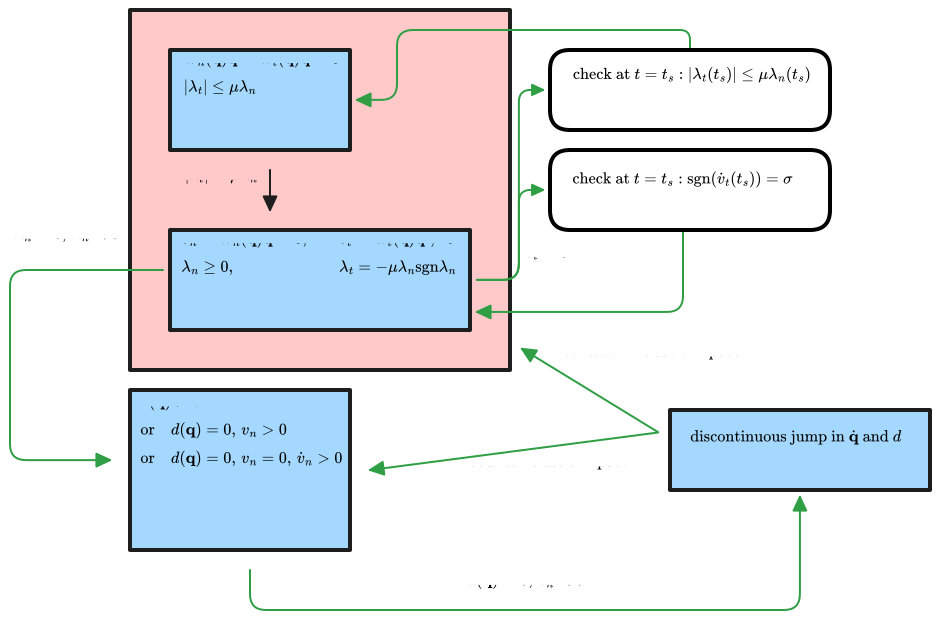
Figure 4.4: General state transition graph for unilateral contact with friction. The graph includes transitions between contact (no-slip), slipping, and separation states.