
Floating Electrode Actuator
In the previous notes we mostly treated voltage-controlled electrostatic actuators, where the electrical loading is prescribed directly by an external voltage source. This lecture introduces a different situation: a suspended conductor carries a fixed charge
The important point is that the suspended electrode is floating. It is conductive, so it has a single electric potential throughout its volume, but it is not directly wired to a voltage source. Its potential is determined by charge redistribution between the variable drive capacitance and the parasitic capacitance.
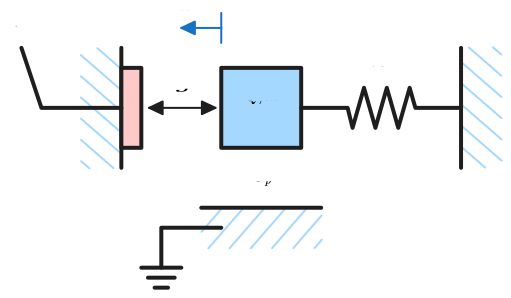
Figure 3.1: Floating electrode actuator.
The variable capacitance between the fixed driving electrode and the floating electrode is
where
Charge Loading Only
First suppose that both fixed electrodes are grounded and charge
The two equations used to derive (3.2) are:
The first equation is charge conservation: the floating electrode carries
Solving (3.3):
The floating electrode voltage
and through the parasitic capacitor,
This agreement is a useful sanity check: the floating conductor must have one potential.
Charge and Voltage Loading
Now the driving electrode is held at voltage
The first term in each expression is the voltage-only contribution, i.e. the charge distribution that would appear if
so the source-driven charge magnitude is
Again,
The first term is a capacitive divider contribution from the applied voltage. The second term is the contribution from the trapped charge.
Total Potential
The energy stored in the two capacitors is
The voltage source also contributes potential energy. When the voltage source moves charge through a prescribed potential difference, the source does work on the electrical subsystem; in the potential formulation this enters with the opposite sign:
Here
The mechanical potential is
Therefore
Why the sign changes
For an isolated charged capacitor, the electrostatic energy is
. For a voltage-driven capacitor, the voltage source supplies or removes charge while holding fixed, so the effective potential contains the familiar term . The floating electrode actuator contains both ingredients: trapped charge and prescribed voltage .
Normalized Potential
Define
Then
and the total potential can be written as
For force and stability, all
The actuator therefore responds only to the effective electrostatic load
This is the central result of the lecture. The trapped charge shifts the voltage axis.
Static Response
At equilibrium
Equivalently,
The two signs correspond to two voltage directions. Because the system already carries charge, pull-in can occur under either positive or negative applied voltage.
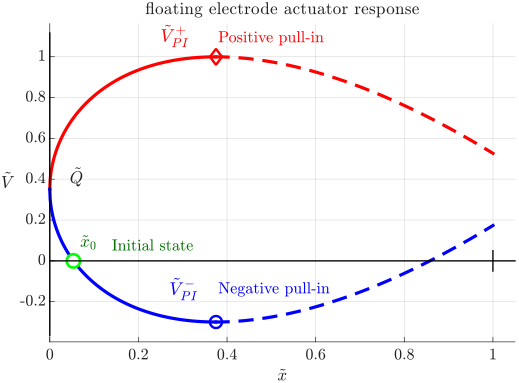
Figure 3.2: Static response of the floating electrode actuator for an arbitrary normalized charge and parasitic capacitance. The charge shifts the standard pull-in curve upward by
, producing positive and negative pull-in voltages.
In the plot, the green point is the initial charged state at
Stiffness and Pull-In
The normalized stiffness is
Substituting the equilibrium condition (3.19) into (3.21) gives the stiffness along the equilibrium branch:
Pull-in occurs when
The critical effective voltage is
and therefore the two static pull-in voltages are
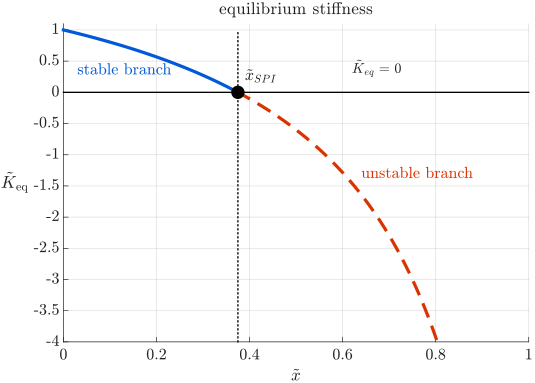
Figure 3.3: Equilibrium stiffness along the response curve. Stability is lost when
.
The initial charge loading is possible only if the trapped charge is not already beyond pull-in:
This means the charge itself can destabilize the actuator, even before any external voltage is applied.
מסקנה:
A floating electrode actuator behaves like a voltage-driven parallel-plate actuator in the effective voltage
. The trapped charge does not change the shape of the pull-in curve; it shifts the voltage axis and creates two possible pull-in voltages.