
Electromechanical Systems with N DOFs and K Voltages
The previous note, MCS2_001 DIPIE, dealt mostly with a single voltage source: one voltage parameter
This lecture generalizes the picture. A microsystem may have
Energy, Equilibrium, and Stability
Let
where repeated voltage indices are summed using Einstein’s summation convention:
Here
The generalized reaction force is
At equilibrium
Equation (2.3) is a force balance: elastic restoring force on the left, electrostatic generalized force on the right.
The tangent stiffness matrix is the Hessian of the total potential:
Since
The smallest eigenvalue is the stability indicator:
- the equilibrium is stable if
- it is unstable if
- it is neutral if
- it is in critical stability if
Pull-in occurs at a critical equilibrium where the smallest eigenvalue vanishes:
The associated eigenvector
Why the eigenvalue matters
A “variation” means a small virtual change in the displacement coordinates. If the equilibrium point is
, we perturb it to . The first variation is the linear change in potential energy, . At equilibrium this term is zero, because the generalized forces vanish. The next term is the second variation: This quadratic term tells us whether every small displacement raises
or whether there is a direction in which decreases.
Pull-In as a Singular Stiffness Condition
A necessary condition for a critical state is
This condition alone is not enough. It only says that some eigenvalue is zero. To identify pull-in, we must also verify that the vanishing eigenvalue is the smallest one and that the state is reachable from the stable equilibrium domain without changing the loading path.
The pull-in states are therefore found by solving the equilibrium equations (2.3) together with
and then checking the eigenvalues.
Voltage-Free Equilibrium Equations
The direct equilibrium equations contain the voltage variables. For many purposes, it is better to eliminate them and describe equilibrium directly in displacement space.
Multiply (2.3) by
Define the
If
Substituting these voltages back into the equilibrium and stiffness expressions gives equations that depend only on the mechanical coordinates. This is the voltage-free representation.
What is gained by eliminating the voltages?
The voltage-free form separates the geometry of the equilibrium domain from the choice of voltage loading. It lets us find critical displacement configurations first, then map them back to the voltages that produce them.
Dimensionality of the Domains
For a single-DOF, single-voltage actuator, the equilibrium set is a one-dimensional curve in the
For a system with
- the equilibrium set is a
- the pull-in set is a
This is why multi-electrode pull-in is not described by one voltage value. For two independent voltages, pull-in is a line. For three independent voltages, pull-in is a surface.
Example: Coupled Parallel-Plate Actuator
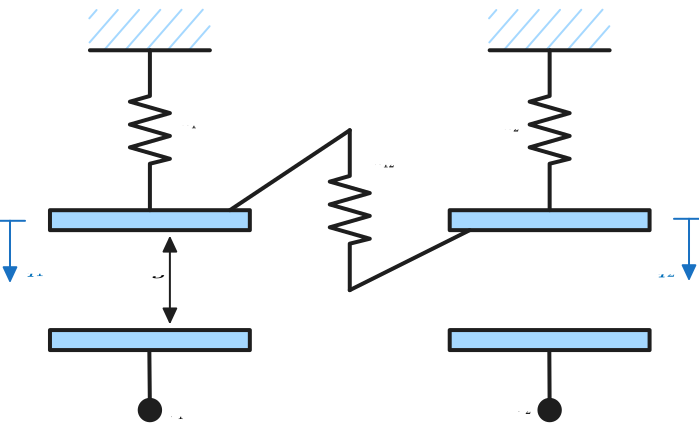
Figure 2.1: Two couples parallel-plates actuators.
Consider two coupled parallel-plate actuators with two generalized displacements
The mechanical potential is
For the symmetric case
The normalized total potential becomes
Taking derivatives with respect to
These equations already show that not every displacement pair is physically reachable. Since squared voltages cannot be negative,
so the equilibrium projection in displacement space is restricted to the wedge between
The stability matrix is
Substituting (2.13) into (2.15) and setting
This equation describes singular stiffness states. Part of it is the actual pull-in boundary, where
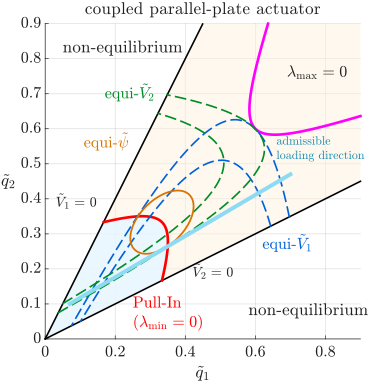
Figure 2.2: Projection of the coupled parallel-plate equilibrium domain onto displacement space. The reachable equilibrium domain is the wedge between the zero-voltage boundary lines. The red curve is the pull-in line, where
. The magenta curve is another singular-stiffness curve, but it has and is not the stable-domain pull-in boundary.
In this graph each point corresponds to a unique displacement state. The stable region starts near the origin, where the stiffness matrix is positive definite. Moving outward eventually reaches the red curve. Crossing it makes one stiffness eigenvalue negative, so the equilibrium becomes unstable.
The two straight black lines are not stability boundaries. They are zero-voltage boundaries:
Outside this wedge one of the squared voltages in (2.13) becomes negative, so there is no real voltage pair that can hold the actuator at that displacement.
Suppose, for example, that the system is on the
The blue contours are equi-
The orange curves are equi-
Voltage Projection
Mapping the same equilibrium states through (2.13) gives a projection onto the
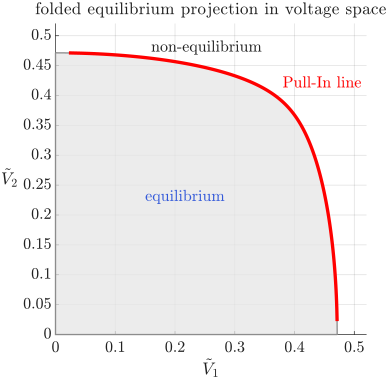
Figure 2.3: Projection of the same equilibrium domain onto voltage space. The map from displacement space to voltage space folds the equilibrium surface, so stable and unstable equilibria can overlap in the projection.
This is why the voltage-space figure in the lecture is visually harder to understand. The plotted region is not a single sheet. It is a projection of a two-dimensional equilibrium surface, and the projection folds over itself. A point in voltage space may correspond to more than one displacement equilibrium, with different stability.
The red curve is still the pull-in line. It is the boundary of the stable operating range in voltage space: if the applied voltages cross this boundary along a given loading direction, no stable equilibrium remains on that loading path.
When
For two voltage sources, an
More generally, choose a direction vector
and write
where
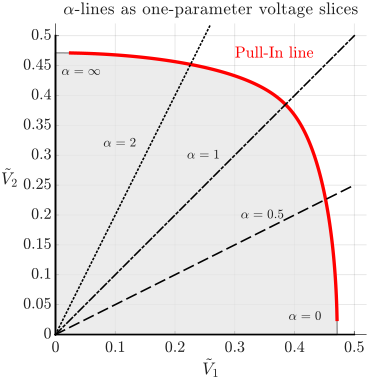
Figure 2.4:
-lines in the voltage projection. Each line fixes a voltage ratio and asks how far one can move along that direction before reaching the pull-in boundary.
The interpretation is direct:
- intermediate slopes describe mixed actuation.
For a selected
Why these are called lines
The name does not mean the mechanical trajectory is a straight line in displacement space. It means the voltage vector moves along a straight line in voltage space. The corresponding displacement path can be curved and may pass through complicated stable and unstable regions.
Example: Interdigitated-Fingers Actuator
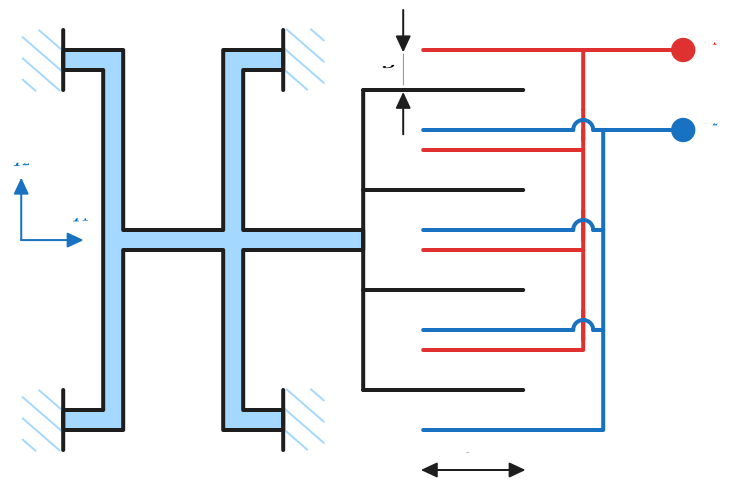
Interdigitated fingers actuator with crab-leg suspension. The well-known comb drive is a special case for which
.
Consider an interdigitated-fingers actuator with crab-leg suspension. The familiar comb-drive case is recovered when the two side voltages are equal,
Let
Where
To derive the stiffness matrix, differentiate the potential (2.18) at fixed voltages. The first derivatives are
Solving the two equilibrium equations for the voltages gives
The tangent stiffness matrix is the Hessian:
Therefore
In the MATLAB code, the voltages in (2.20) and (2.21) are substituted into these entries before computing the eigenvalues of
The pull-in equation is derived in the form
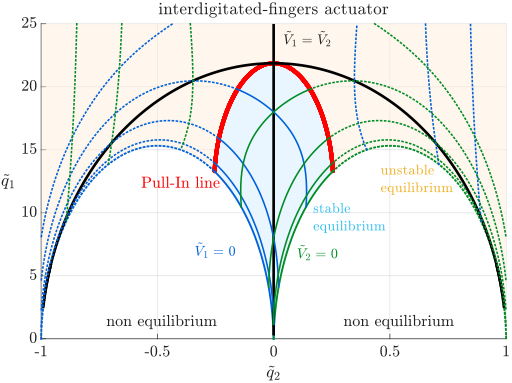
Figure 2.5: Projection of the interdigitated-fingers equilibrium domain onto displacement space for
. The red curve is the pull-in line. The vertical line is the comb-drive direction, where and the electrostatic force is mainly axial. The side regions are excluded because one of the required squared voltages becomes negative.
The meaning of this figure is the same as in the coupled parallel-plate example, but the geometry is different. The two side electrodes create forces in opposite transverse directions. Equal voltages cancel the transverse component and pull the shuttle in the axial direction. Unequal voltages introduce a transverse bias, so the equilibrium path bends toward one side gap.
The dashed and dotted curves are iso-voltage curves. The red pull-in line is where the smallest eigenvalue of the stiffness matrix vanishes.
Connection to DIPIE
The
A practical workflow is:
- Choose a voltage direction
- Substitute
- Use a displacement-controlled solver such as DIPIE to trace equilibria along that slice.
- Compute the stability matrix at each equilibrium.
- Identify the point where
- Sweep over many
This is the conceptual reason the lecture combines
What to remember
For one voltage, pull-in is a point on an equilibrium curve. For two voltages, pull-in is a curve in voltage space. For three voltages, it is a surface. The stability condition is always the same: the smallest eigenvalue of the tangent stiffness matrix goes to zero.