
Dynamic Pull-In in One DOF Actuators
The static pull-in voltage of a voltage-controlled electrostatic actuator is found from the equilibrium curve. Dynamic pull-in asks a different question: if the actuator starts from rest at the undeformed position and a voltage step is applied, what voltage is large enough that the motion cannot remain bounded by the stable well?
Consider the parallel-plate actuator with spring stiffness
Define
Then
The mechanical reaction force needed to hold the plate at
Equilibrium requires
The stiffness along an equilibrium state is
The static pull-in state is therefore the limit point of (6.5):
Energy Constraint
For the dynamic response, the kinetic energy must be included. The Hamiltonian is
Use the normalized time and Hamiltonian
Then
The voltage is applied as a step at
If mechanical and electrical dissipation are neglected,
Since
the motion must satisfy the energy constraint
Why dynamic pull-in can occur below static pull-in
Static pull-in asks whether a stable equilibrium exists at the applied voltage. Dynamic pull-in asks whether the step response has enough conserved energy to pass the unstable equilibrium barrier. Because a voltage step injects energy instantly, collapse can occur even when a stable static equilibrium still exists.
Stagnation Curve
A stagnation state is a point on the trajectory where the velocity vanishes. Setting
For any fixed voltage, the stagnation equation has the roots
Equivalently, the nonzero stagnation branch satisfies
The dynamic pull-in state is where the stagnation curve reaches its maximum voltage. At that point the stable and unstable stagnation branches coalesce, and the point also lies on the unstable branch of the static equilibrium curve:
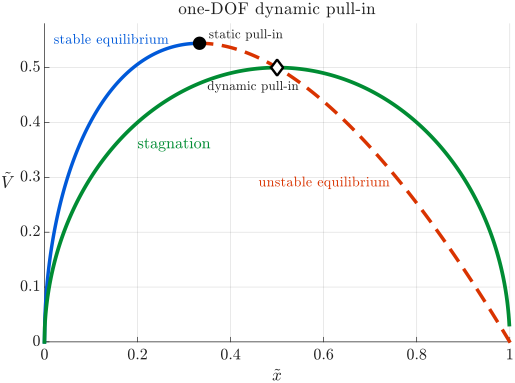
Figure 6.1: Equilibrium and stagnation curves of the normalized one-DOF parallel-plate actuator. The dynamic pull-in point lies on the unstable static branch and occurs before the static pull-in voltage is reached.
For the one-DOF parallel-plate actuator,
Thus the undamped dynamic pull-in voltage is about
If viscous damping is present, the actual pull-in voltage lies between the conservative dynamic value and the quasi-static value:
Two-DOF Actuator
Now consider a double parallel-plate actuator. Two equal moving electrodes are attached to ground by springs of stiffness
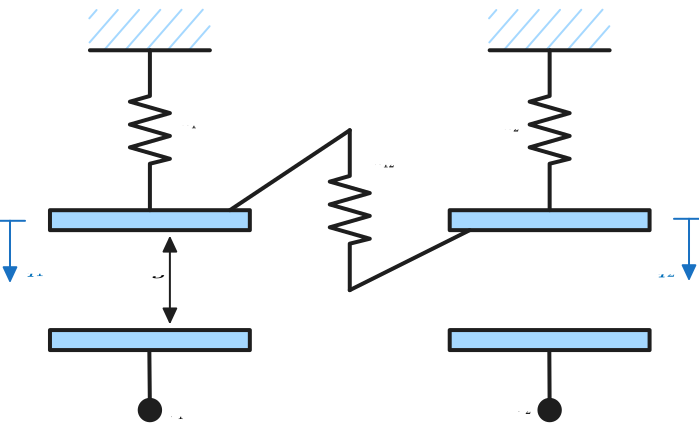
Figure 6.2: Two couples parallel-plates actuators.
The normalized potential is
The reaction forces are
Equilibrium therefore gives the voltages as functions of displacement:
Voltage normalization convention
The stiffness matrix is
Static pull-in occurs when the smaller eigenvalue of
Dynamic Pull-In Line
The normalized Hamiltonian is
With the initial state
energy conservation gives
Setting the velocities to zero defines the stagnation domain. The dynamic pull-in line is obtained from the intersection of this stagnation domain with the equilibrium domain. Substituting (6.22) into the stagnation condition gives
Each point on (6.28) is mapped to a pair of voltages using (6.22).
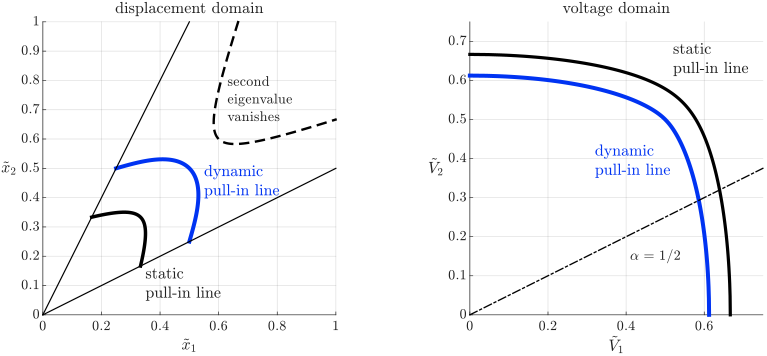
Figure 6.3: Static and dynamic pull-in lines of the double parallel-plate actuator. The dynamic line is found by intersecting the equilibrium domain with the stagnation domain.
Alpha Lines
For multiple voltage sources, “the maximum voltage” is not unique unless a loading path in voltage space is specified. The lecture uses an alpha-line:
For a fixed
Repeating this calculation for all
For
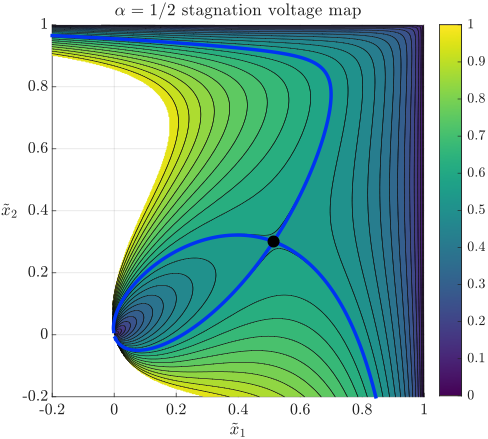
Figure 6.4: Stagnation voltage map for the double parallel-plate actuator with
. The color field shows the scalar driving voltage , the black curves are equi-voltage contours, and the blue contour is the critical contour through the dynamic pull-in point.
Stagnation is necessary but not always sufficient
The stagnation line contains all energetically possible zero-velocity states, but the actual trajectory visits only some of them. In multi-DOF systems, the pull-in voltage extracted from the stagnation-equilibrium intersection is therefore a lower bound unless the trajectory is shown to pass through the critical opening.
Dynamic Pull-In Hyper-Surface
For a general electrostatic actuator with
Here
Because the system starts from rest at the unloaded state, the stagnation function is the difference between the potential at the current state and the potential immediately after the voltage step:
The derivatives of
Therefore, an equilibrium point that also satisfies the stagnation condition is a stationary point of the voltage level on the stagnation manifold. If the capacitances are monotonic, the dynamic pull-in condition can be interpreted as an extremum of the applied voltages subject to the stagnation constraint.
The dimensional count is also useful:
- the static pull-in hyper-surface has dimension
- the dynamic pull-in lower-bound hyper-surface also has dimension
Clamped-Clamped Beam Actuator
The same idea applies to distributed systems. A clamped-clamped beam over a fixed electrode has infinitely many mechanical DOFs, represented by the transverse deflection
The total potential used in the lecture is
The first term is bending energy, the second term is stretching energy caused by clamped-clamped inextensibility, and the last term is electrostatic co-energy with a fringing-field correction
Using
the normalized potential can be written schematically as
The static equilibrium curve is computed with the DIPIE idea from Lecture 1: prescribe the center deflection
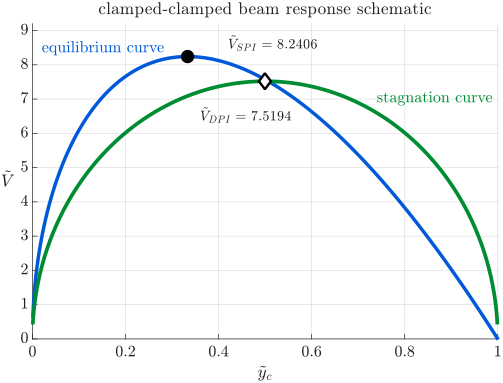
Figure 6.5: Lecture-value schematic of the equilibrium and stagnation curves for a clamped-clamped beam actuator. The dynamic pull-in voltage is lower because the voltage step injects kinetic energy into the beam response.
For the simulated clamped-clamped beam in the lecture,
Thus the dynamic pull-in voltage is about