
Distributed Systems and Beam Theory
In the introductory course, we analyzed microsystems using lumped-parameter models. That is, models in which we simply had a spring stiffness
Real MEMS beams, however, are distributed systems with infinitely many degrees of freedom. The deflection
Euler-Bernoulli Beam Theory
As developed in beam bending theory, the Euler-Bernoulli assumption relates the bending moment
where
where
In most practical cases, the curvature can be approximated as:
This expression is essentially a change of coordinates: in
For small slopes (where
Deriving the Beam Equation
Consider a beam of length
This expression states that the moment at
Differentiating once with respect to
where we applied the Newton-Leibniz rule. Differentiating once more gives the known fourth-order beam equation:
This is the fundamental governing equation for static beam deflection under distributed loading. For an electrostatic actuator,
Finite Difference Approximation
To solve the beam equation numerically, we discretize the beam into equally spaced nodes separated by distance
Symmetric (Central) Differences
We start from the Taylor expansions of
By rearranging these expressions one can obtain the central difference formulas. These provide second-order accuracy
Looking at (1.10), we see that the coefficients that multiply the nodal values are
Backward (One-Sided) Differences
At boundaries where central differences cannot be applied (because nodes to one side do not exist), we resort to backward differences. These are also
The Clamped-Clamped Beam Actuator
We now apply the beam theory to a clamped-clamped beam suspended above a fixed electrode, with an initial gap
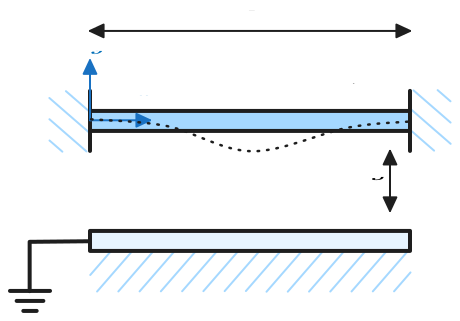
Figure 1.1: Clamped-clamped beam actuator system
When voltage
The governing equation couples the mechanical beam equation with the electrostatic pressure:
where
Moving to dimensionless variables, we define:
For a rectangular cross-section with width
Rearranging to isolate the normalized voltage parameter:
where we defined the normalized voltage:
We discretize the beam using
Applying the fourth-derivative stencil
As a concrete small example, consider a beam discretized with nodes
The ghost node values are determined by the zero-slope (clamped) boundary condition
Applying the same argument one step further (zero slope at the same point implies the displacement profile is locally even about the clamped node):
The right boundary gives the symmetric result:
Therefore we can now write:
Due to displacement boundary condition (
For any number of nodes, the resulting system can be written as:
where
Solving the Nonlinear System
Voltage Iteration (VI) Method
The system in (1.18) is nonlinear because the right-hand side depends on
This iteration converges when the mechanical restoring force dominates the electrostatic force - i.e., when the system is on the stable equilibrium branch. Near and beyond pull-in, the iteration diverges because the electrostatic force grows faster than the mechanical restoring force.
The convergence behavior of voltage iteration is shown in Figure 1.2 below for a range of normalized voltages

Figure 1.2: Convergence of the midpoint displacement under voltage iteration. Each curve corresponds to a different normalized voltage
. Lower voltages converge in a few iterations; convergence degrades sharply as .
For low voltages (
The physical interpretation is straight-forward: at low voltages, the electrostatic force is a small perturbation to the stiffness matrix and the fixed-point iteration contracts rapidly. Near pull-in, the electrostatic “softening” almost cancels the mechanical stiffness, making the contraction ratio approach
By sweeping through these converged solutions, we can trace the equilibrium curve

Figure 1.3: Equilibrium curve obtained by voltage iteration. Only the stable branch is accessible - the curve terminates near pull-in without revealing what happens beyond.
The equilibrium curve flattens as it approaches pull-in, and voltage iteration simply cannot continue past this point. This presents a fundamental limitation: voltage iteration cannot access the unstable equilibrium branch of the displacement-voltage curve. It also cannot pinpoint the pull-in voltage precisely, since convergence degrades severely in its vicinity. For engineering design, where knowing the exact pull-in parameters is critical, we need a better algorithm.
DIPIE Algorithm
The Displacement Iteration Pull-In Extraction (DIPIE) algorithm, introduced in (Bochobza-Degani et al., 2002), overcomes the limitations of voltage iteration by inverting the problem: instead of prescribing the voltage and solving for displacement, we prescribe a displacement at a chosen node and solve for the voltage that produces it.
This is conceptually analogous to the difference between load-controlled and displacement controlled testing in mechanics. In a displacement-controlled experiment, we can trace the entire force-displacement curve - including the descending (unstable) branch - because we directly control the independent variable.
Similarly, DIPIE can trace both stable and unstable equilibrium branches.
The discretized equilibrium equations for the clamped-clamped beam are:
where all nodes share the same voltage
How can relaxing the voltage uniformity comply with the physics? In reality, the voltage is uniform across the beam, so how does allowing different nodal voltages help?
The key insight is that the non-uniform nodal voltages are an intermediate artifact of the iteration, not the final answer. During the iteration, the displacement field
is not yet at equilibrium, so if we back-calculate what voltage each node “thinks” it sees, we get different values at different nodes. As the iteration converges, the displacement field approaches the true equilibrium shape, and the nodal voltages all converge to the same value - the true applied voltage. The variance is a measure of how far the current iterate is from equilibrium: it vanishes at convergence.
From these local voltages, we can estimate the average voltage:
Now rewriting equation (1.21) using the average voltage plus a local variance:
where
We prescribe the displacement at the midpoint:
The crucial observation is that as the iteration converges, the nodal voltage variance
The converged solution therefore satisfies the original uniform voltage equation.
Iterative Procedure
The DIPIE iteration proceeds as follows:
- Initialize: Set
- Compute local voltages: From the current displacement field, compute:
- Compute average voltage:
- Solve for displacements: With
- Repeat from step 2 until convergence.
Why DIPIE Works Beyond Pull-In
The physical intuition is as follows. In voltage iteration, we fix the cause (voltage) and solve for the effect (displacement). Near pull-in, a tiny voltage increment produces a large displacement change, and beyond pull-in, no equilibrium exists for a given voltage - the beam snaps to the electrode. The iteration reflects this instability by diverging.
In DIPIE, we fix the effect (midpoint displacement) and solve for the cause (voltage). For every midpoint displacement between
Equilibrium Curve
By sweeping

Figure 1.4: Full equilibrium curve obtained by the DIPIE algorithm (
nodes). The solid blue line is the stable branch; the dashed red line is the unstable branch. The dot marks the pull-in point at , .
The curve has two branches:
- Stable branch (solid blue): from
- Unstable branch (dashed red): beyond pull in. Here
On the unstable branch, to maintain equilibrium at a displacement closer to the electrode, you actually have to decrease the voltage. Why? Because the gap is so small that a high voltage would provide way too much force for the beam to resist. You have to “turn down” the voltage to keep the beam from snapping.
General Governing Equation
The simple beam equation (1.15) neglects two effects that become important at larger deflections:
- Residual stress
- Mid-plane stretching: as the beam deflects, its centerline stretches (recall from the string model that stretching produces a nonlinear restoring force proportional to